Victor
The SwarmVictor is a remotely operated vehicle whose cameras and instruments extend the Thorvaldson’s reach into the deep sea, turning an unseen seabed into a live feed watched from a crowded control room. It can work at depths of up to six thousand metres and remain underwater for days, but the discoveries it brings back also expose the limits of remote observation: its images can reveal something extraordinary without making that thing understood.
Design and purpose
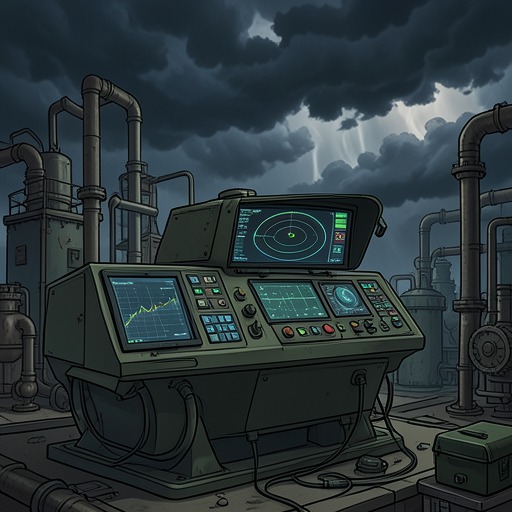
On the Thorvaldson, Victor is a three-metre-high, open-sided box suspended from a hydraulic boom. Cameras and an articulated arm are mounted at the front, while the name Victor appears on the outer casing of its lid. The vehicle is an ROV: unlike a submersible carrying people, it is piloted from the ship and connected to the control room by cable. That link carries data back as its operators guide it through the water.
Jean-Jacques Alban describes the model as a Victor 6000, with a working depth of six thousand metres and the capacity to stay submerged for days. The planned survey is a forty-eight-hour reconnaissance, including a request to retrieve worms. The mission serves the seabed investigation associated with Statoil, which Alban says takes pride in preserving biodiversity. At this stage, Sigur Johanson considers it too early to say what the creatures mean; Victor’s task is to make observation and sampling possible before the evidence has been interpreted.
The vehicle and its operators
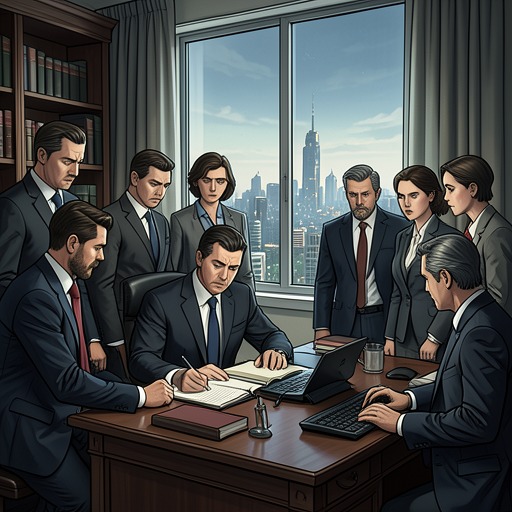
Victor’s apparent independence depends on a coordinated human crew. Its control room occupies the forward container on the ship and is crowded with a control panel, two banks of screens and consoles staffed by Lund and other operators. The pilot directs the vehicle; the co-pilot works the articulated arm; and a coordinator keeps in contact with the watch officer on the bridge so that the ship and ROV can work together. Tina Lund operates the cameras and records the footage. Victor is described as sensitive and precise, but those qualities are useful only when matched by an equally skilled operator.
The video system consists of eight cameras: one main camera with zoom, two piloting cameras and five others. Once the screens switch on, those aboard can see what Victor sees, from the stern, boom, sky and sea at launch to the changing water below. The images are described as sharp and luminous in colour even at depths of several thousand metres. This arrangement makes the control room a viewing station as well as a workplace: the vehicle goes down, while its operators and scientists follow its progress through a set of mediated views.
Discoveries in the deep
As Victor descends, the blue-green water grows dimmer. Its lights reveal a fissured white sheet of frozen methane, identified as evidence of hydrates. The camera then shows what lies across the deposits: a writhing mass of pink bodies, with white bristles curling among them. For a moment individual forms can be made out; then their numbers make counting impossible. The remote image brings the worms into view at a distance that would otherwise conceal them, and turns a geological survey into an encounter with an abundant living presence.
The descent also brings Victor to a hundred-metre vertical drop. After the screens go dark, the vehicle launches over the edge and races onward. At Lund’s direction it turns towards the wall. Particles move through the floodlights; then something large and bright billows into the frame and retreats with extraordinary speed. The sighting is brief, and the people watching have no clear identification for it. Victor’s equipment makes the encounter visible, but the speed and incompleteness of the image preserve its uncertainty.
Evidence, limits, and human vision
Later, the disappearance of a subsea processor leaves the Thorvaldson’s team searching a seabed whose morphology appears to have changed. A survey with multibeam sonar finds no sign of the unit, and within days its site has become a gaping chasm. Victor is available for a reconnaissance: it has powerful cameras, a highly sensitive articulated arm and instruments for rapid data evaluation. Jean-Jacques Alban and others urge Clifford Stone to send the robot down first. Stone instead chooses to descend in a manned Deep Rover, believing that being on the seabed and seeing it in three dimensions offers something video cannot provide. The choice sets Victor’s remote precision against the value Stone assigns to direct human perception; it does not erase the vehicle’s technical advantages, but makes clear that those advantages do not settle every question of what can be known.
As Stone rises in the Deep Rover, he wonders whether its video cameras registered the weak glow he has just seen. He then recalls the peculiar footage Victor recorded of a creature retreating from the light. The earlier image gives the new sighting a possible connection, without confirming what the bright thing is or whether the camera can reliably capture it. Victor therefore occupies an uneasy boundary between instrument and witness: its lights and cameras disclose a presence in the darkness, while the limits of the resulting image leave that presence unresolved.